We had walked Kaleiçi enough times to think familiarity might have made it smaller. That afternoon, Sayda and I decided to look as carefully as if we had just arrived in Antalya.
TBy Traveler·
Day 1
History, Heat and a Long Walk
From the morning onward, we kept postponing our departure. The August heat had drained the enthusiasm out of both of us, and even the thought of leaving the house felt tiring. We finally committed in the late afternoon, though in August that part of the day can still carry the force of noon.
Living in Antalya changes your relationship with heat. You stop expecting to defeat it. You sweat through the humidity, slow down and gradually learn how to move with it. Then the long rainy season returns, and the city makes you miss the sun you once tried to escape. I will save the stories about dancing under Antalya’s wild rain for another day. This one began with us looking for shelter from the sun inside the city’s history.
We drove from Güzeloba, in the Lara area, towards the center. Traffic stretched the journey to roughly half an hour, and the number of people already out made the city feel especially busy. We parked at Antalya Büyükşehir Belediyesi Kapalı Otoparkı and started walking towards Hadrian’s Gate.
The walk took us about fifteen minutes. We passed a park, cafés and restaurants along Atatürk Caddesi, but my attention kept returning to the old wall beside the modern street. On one side were traffic, shopfronts and people moving through an ordinary afternoon. Behind the stone was another kind of city. The boundary was physical enough to touch.
We could have entered Kaleiçi earlier through Yeni Kapı Sokak, near the turn between Işıklar and Atatürk Caddesi. It was the more direct choice, but we wanted our fresh look at the old city to begin through its most dramatic entrance. So we stayed outside the wall a little longer and walked towards Hadrian’s Gate.
The gate everyone stops for
We knew we had reached it before we were directly in front of it because the pavement had become a loose choreography of cameras. One person was filming. Another was arranging a pose. Families, couples and solo travelers waited for a clear second beneath the arches, then discovered that a truly clear second was unlikely to come. Everyone seemed to understand that this was not a place to pass without looking.
19 video moments
Watch the journey
Step into the moving moments, then continue through the Story in order.
Start watching to continue through all 19 videos in sequence.
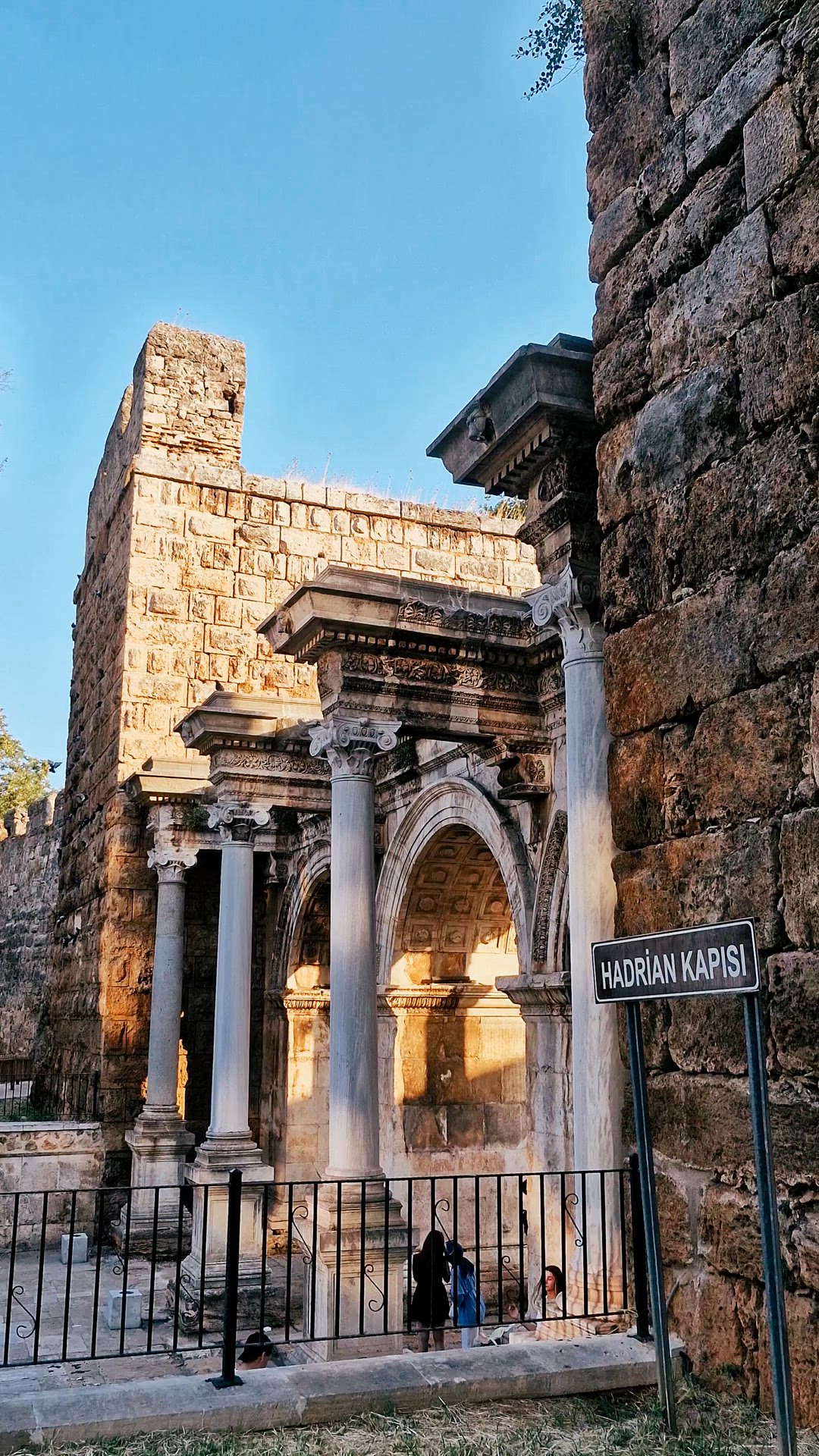
Hadrian’s Gate, also called Üçkapılar, was built for the Roman emperor Hadrian’s visit to Attaleia in AD 130. Its three arches once formed an entrance through the city wall. It was later closed into the Byzantine defenses, a change that helped protect it from later damage. The surviving structure is mostly pale stone and marble, flanked by towers from different periods. That basic history explains its importance, but the details explain why people remain beneath it after they have taken the obvious photograph.
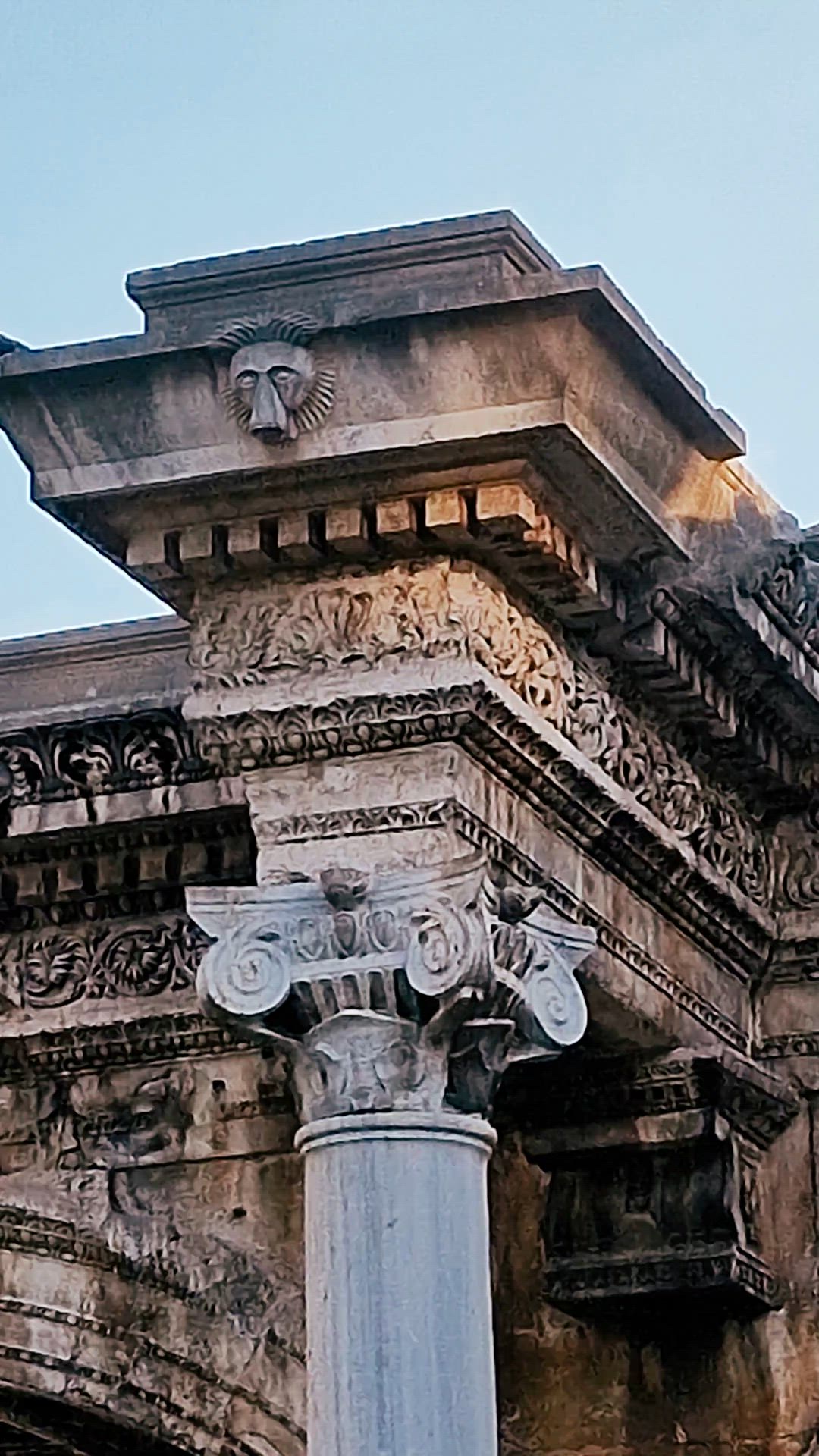
Sayda photographed the gate. I did too. Then we tried to look past the grand shape that everyone sees first. Above us, floral and rosette-like carvings filled the undersides of the arches. There were worn capitals, small shifts in color across repaired stone, and a lion’s head projecting from the decoration near one end. The longer we looked, the less the gate felt like a single Roman object frozen in one century.
The inscription in one of my photographs made that especially clear. It is set into the northern tower wall and written in Arabic script. It is not a Roman dedication. The text records work ordered in 1220 during the reign of the Seljuk sultan Alaeddin Keykubad. A person could easily photograph the famous Roman gate, miss that small panel, and leave without noticing that later Antalya had written itself onto the same entrance.
Eventually, we stepped through. It was not time travel, of course, but the first few meters did feel like a change in tempo.
Inside Kaleiçi
Kaleiçi is Antalya’s walled old town, gathered above the sheltered harbor at the center of the modern city. Attaleia was founded in the Hellenistic period and later passed through Roman, Byzantine, Seljuk and Ottoman rule. Those periods do not sit in separate, tidy zones. Their traces overlap in walls, reused stone, religious buildings, street lines and the shape of the harbor below.
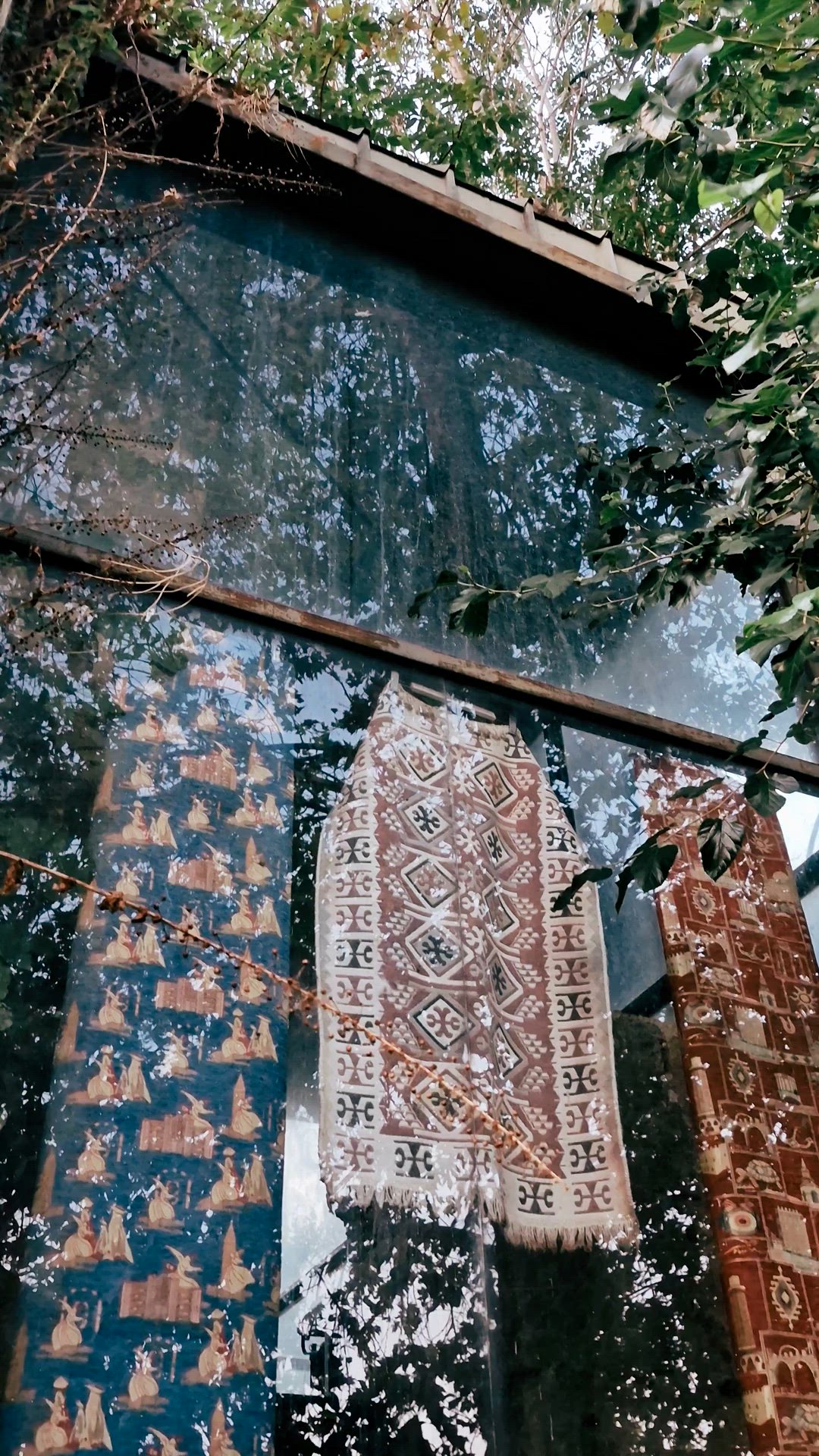
That layered history matters, but it was not what we experienced every minute. Much of our walk was more immediate: stone under our feet, timber-fronted houses leaning into narrow lanes, souvenir displays bright with blue glass eyes, small courtyards, flowering balconies and menus placed wherever a patch of pavement allowed. We moved between streets full of visitors and quieter turns where the noise dropped away almost at once.
Kaleiçi is not preserved as a silent museum. People live and work inside it. Cafés occupy old courtyards, restaurant tables sit beneath stone walls and music escapes from bars. Nearby, plants and domestic details mark houses that are still lived in. Signs, cables and scooters share the view with the older architecture. I like it more for containing all of those things at once.
We did not follow an efficient route. We stopped whenever a façade, doorway or unexpected view held us. A lane would seem to be leading downhill, then bend and offer a minaret between roofs. Another would open briefly onto a busy square before narrowing again. Our complete walk took hours, and that wandering was the experience rather than a delay between landmarks.
The Clock Tower and the center of the crowd
At Kale Kapısı, Antalya Saat Kulesi rose above one of the busiest parts of our route. It stands on an old bastion and dates to 1921, which makes it much younger than the walls and monuments surrounding it. Its dark, rough stone and clocks give the square an immediate focal point, even when buses, signs and streams of pedestrians compete for attention.
We paused long enough to photograph it from below. This was not the contemplative part of our day. The square was active and exposed, a place of crossings rather than quiet. Yet that suited the tower. It did not need silence to hold its position over the center.
Nearby, we passed the statue of Attalos II, the ruler traditionally associated with the founding of Attaleia. It offered another reminder that in Kaleiçi a short walk can move across centuries without announcing every transition.
Beneath the Yivli Minaret
The Yivli Minaret had been appearing and disappearing between rooftops before we reached its complex. Its fluted red-brick shaft is one of Antalya’s clearest silhouettes, but standing beneath it changed the scale. The minaret felt tall and unmistakably public; the mosque beside it felt comparatively small and contained.
The present Yivli Minare Mosque belongs to a site shaped by more than one building phase. An on-site panel we photographed associates an earlier mosque with the reign of Alaeddin Keykubad I and dates the present multi-domed building to 1373, when Mehmed Bey had it rebuilt. The panel also records its later use as Antalya’s archaeology museum before the mosque returned to worship. The sequence is complicated, which seemed appropriate after the gate had already taught us to stop assigning every surface to a single period.
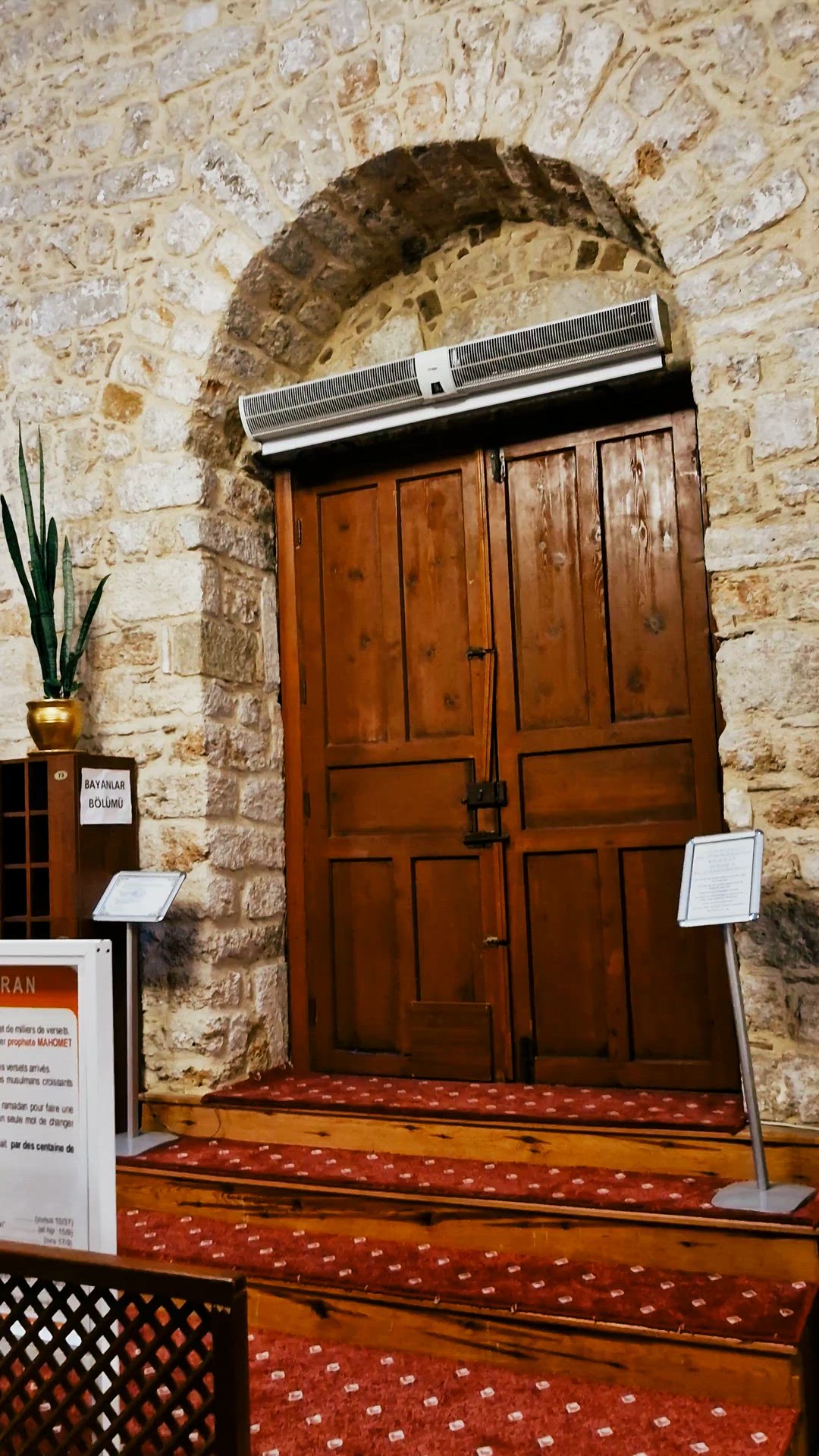
This is an active place of worship as well as an architectural landmark. We removed our shoes and dressed accordingly; women should cover their hair and everyone should wear clothing suitable for a mosque. Sayda used a covering provided at the entrance during our visit. Visitors should keep their voices low, stay clear of worshippers and follow any instructions at the entrance.
Inside, red carpet ran beneath stone arches and a series of shallow domes. What held us longest, though, was beneath the floor. A glass panel revealed stone-lined water channels and a large ceramic storage vessel, or pithos. My first thought was that we were looking at an old plumbing system, but the information panel is more careful. It says the channels were uncovered during restoration from 2006 to 2010 and presents several possible uses: moving hot or cold water, storing water in the vessel, or supplying a fountain for ablution. It does not settle on one explanation, so neither should we.
I liked the panel more for admitting uncertainty. We were looking at surviving evidence together with the limits of what could responsibly be said about it.
Down to the Old Harbor
From the upper streets, the route began to pull us downhill. The sea appeared in partial views, then disappeared behind walls and roofs. The paving became something we had to pay attention to. Kaleiçi rewards walking, but its polished stones, steps and steep lanes ask for proper shoes and a little patience, especially in summer heat.
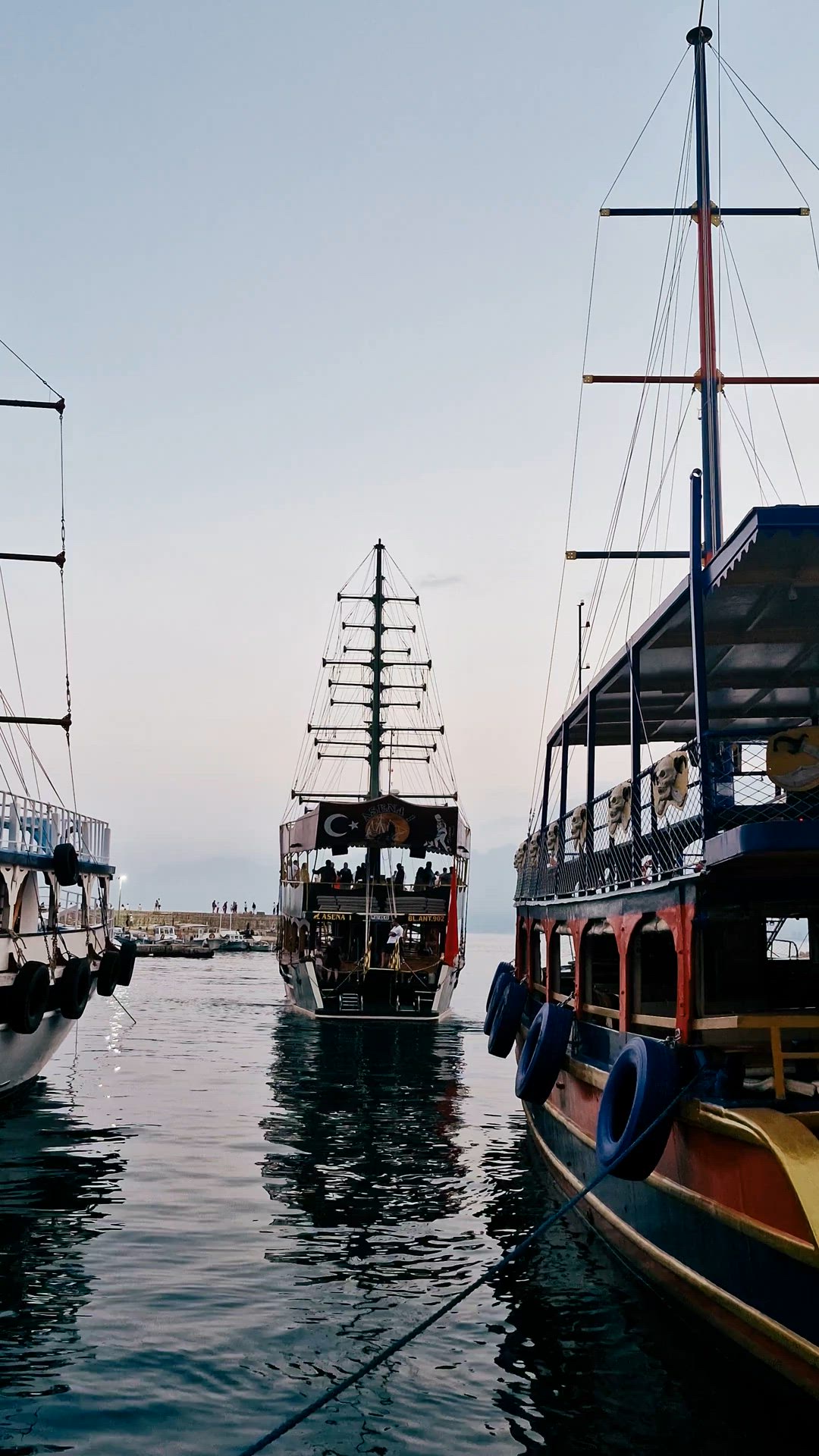
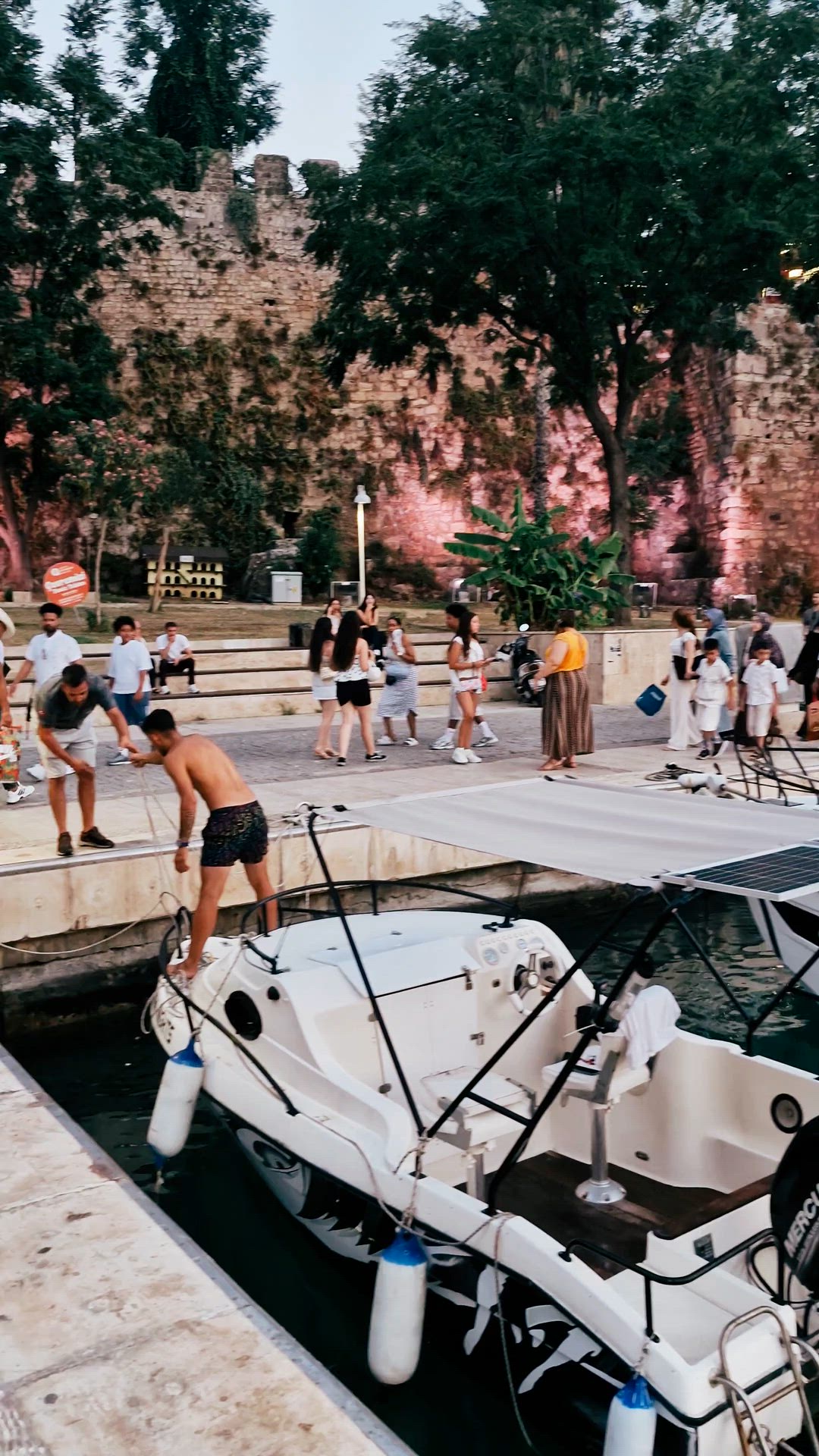
The Old Harbor, or Yat Limanı, sits in the natural curve below the old city. That sheltered water helped shape Antalya’s life from antiquity onward; on our evening, it held a much more contemporary mix of tour boats, small yachts, swimmers and ticket stands.
Some of the excursion boats wore their entertainment openly, with high decorative sterns and pirate-style details. Sellers called out departures from kiosks along the quay. Several advertised sea trips towards the Lower Düden Waterfall, where the river drops from Antalya’s cliffs into the Mediterranean. We had seen that waterfall from land before, and the idea of approaching it from the water stayed with us, but we did not take a cruise that day. Routes, departure times, weather conditions and prices change, so those are details to confirm with current operators rather than inherit from our walk.
We had come for sunset. Warm orange light moved across the harbor while the boats settled into dark shapes against the water. Above them, the old-city walls and cliffs caught the last brightness. We watched people negotiate tickets, crews prepare boats and swimmers use the rocky edge as if the whole scene were an ordinary neighborhood waterfront.
Near the water, we slowed down, held hands and stood together for a while. Even with the busy quay behind us, the pause felt private. It was a simple reminder that we had chosen to spend the day together.
On one of the sloped lanes, Sayda’s ankle twisted. For a few seconds, the entire walk reduced itself to one question: was she all right? Luckily, the pain eased and there was no serious injury. We stopped, checked it and rested before continuing. The photograph of that pause is less beautiful than the sunset images and more useful. Kaleiçi’s distances may look modest on a map, but hours of heat, stone paving, slopes and steps accumulate. Wear shoes meant for a long walk, and do not treat the downhill sections casually.
Ten quiet minutes at Şehzade Korkut Mosque
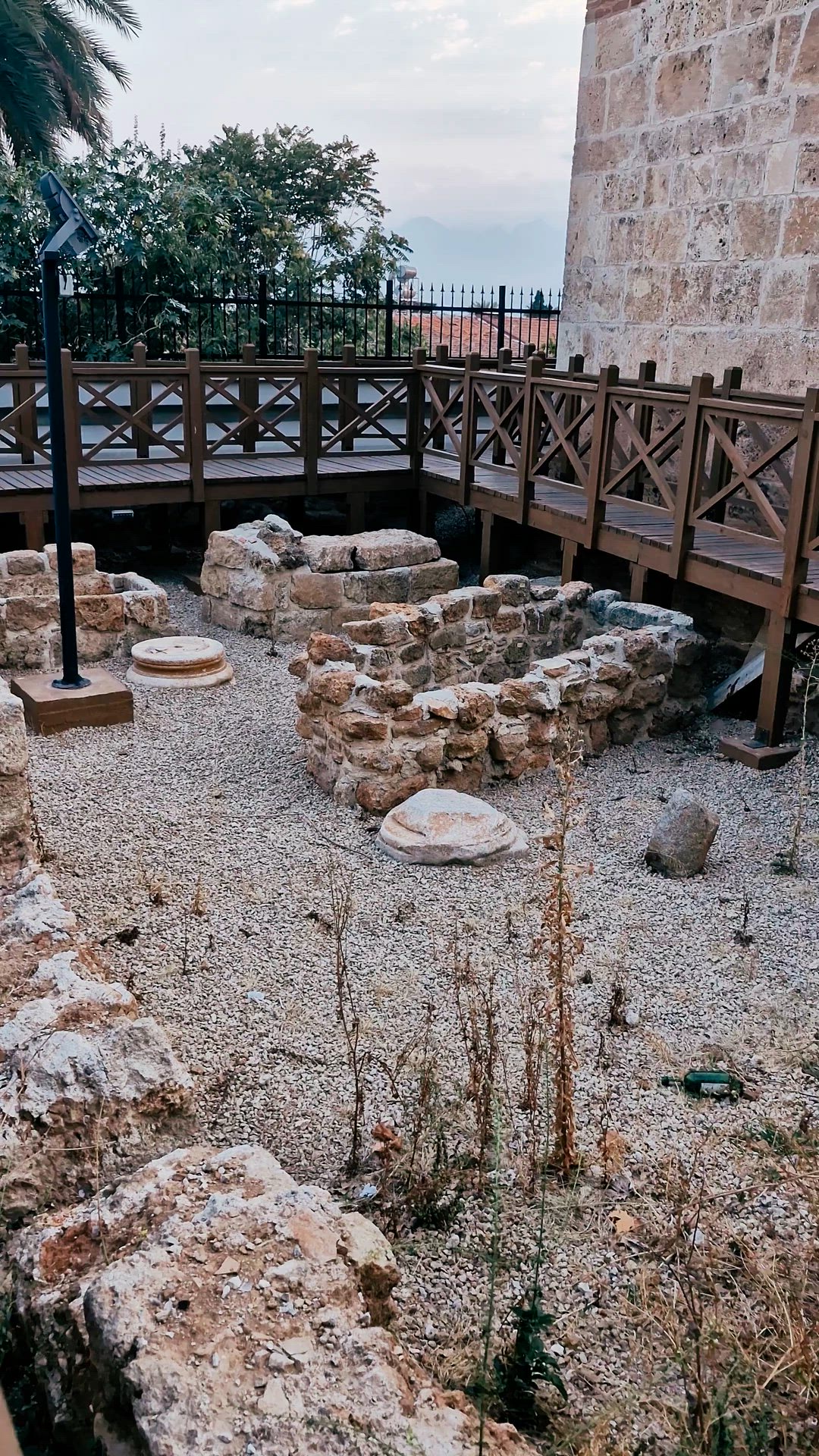
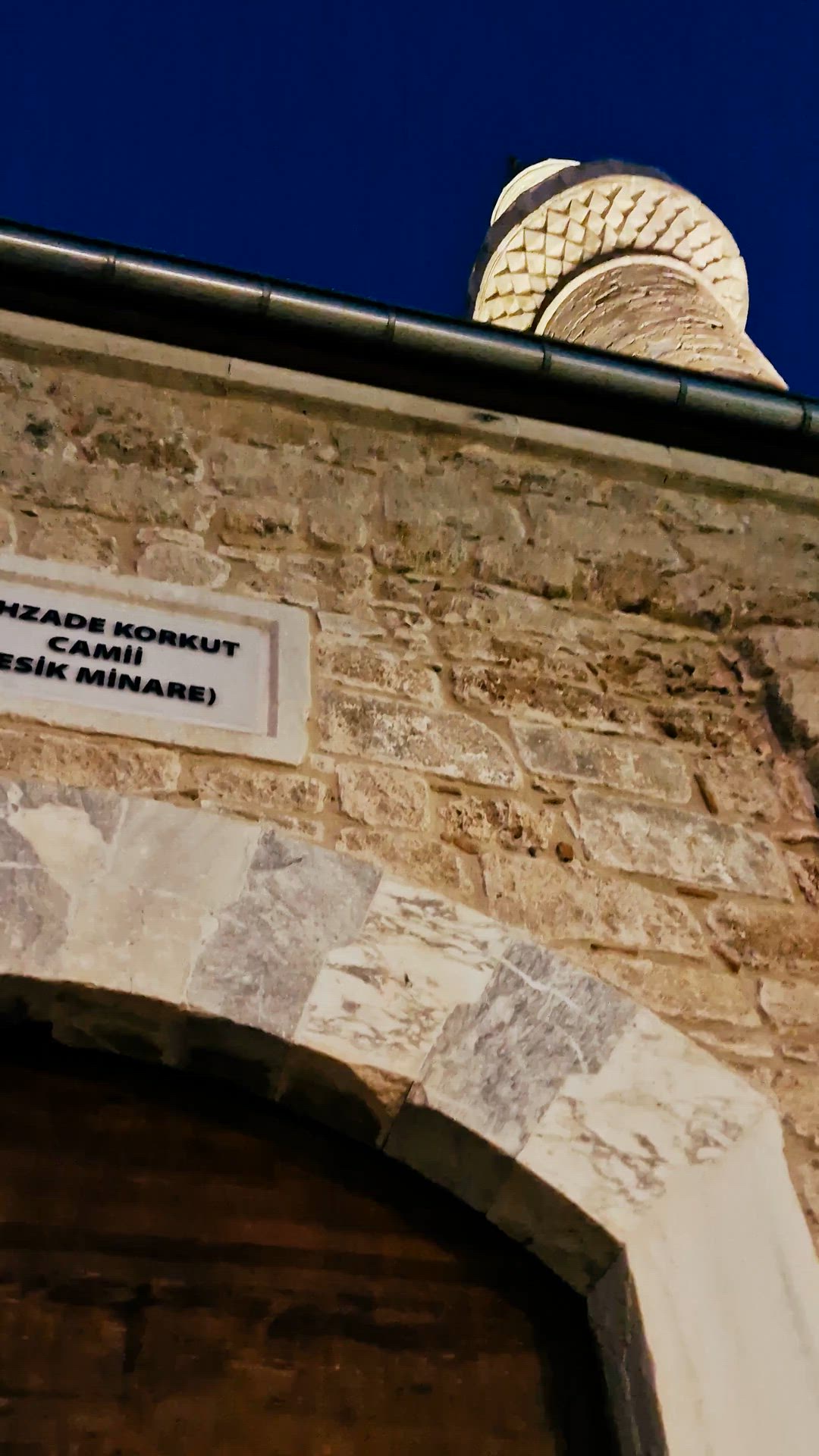
Night had reached the lanes by the time we came to Şehzade Korkut Mosque, also known as Kesik Minare. Its calm was immediate. The site has carried several lives: archaeological work has identified parts of an ancient public complex, a large Byzantine church, later religious use and an Ottoman mosque. A late-nineteenth-century fire left the minaret damaged and gave Kesik Minare, the “cut minaret,” its familiar name. Recent excavation and restoration preserved architectural fragments and reopened the building as a mosque.
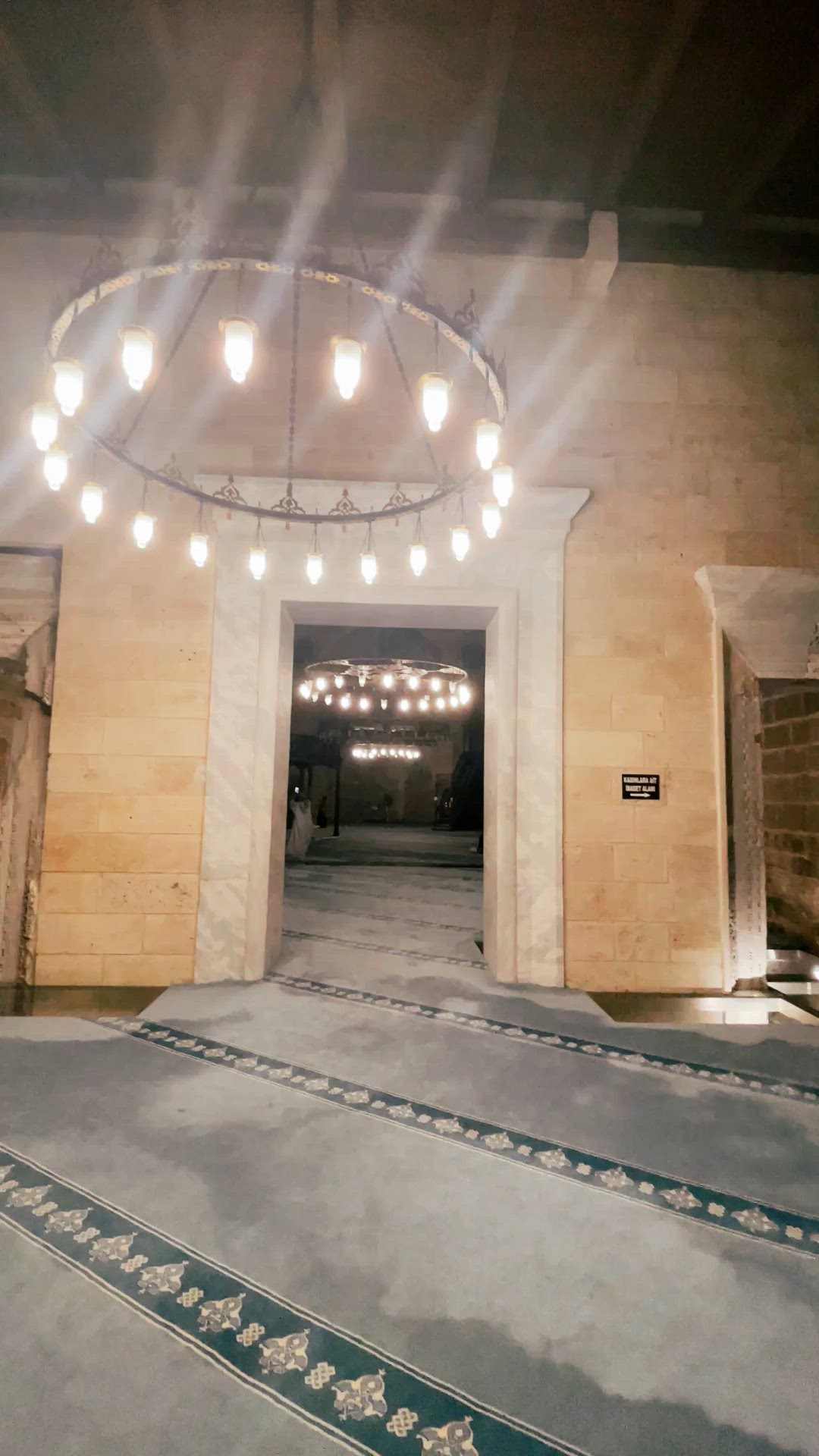
Glass walkways inside let us look down at excavated masonry and architectural fragments retained through restoration. We could look closely without pretending we could date or name every piece.
We walked slowly around the illuminated stone arches, then sat in a corner for about ten minutes. Neither of us needed to turn the pause into a declaration about belief. We were tired, the room was quiet, and for a while the noise of the streets and the ordinary pressure of life stayed outside. We spoke carefully when we spoke at all.
That rest became one of my strongest memories of the outing. Grand monuments are easy to remember because they announce themselves. Ten quiet minutes ask more of your attention.
Kaleiçi after dark
By the time we stepped back into the lanes, daytime Kaleiçi had largely disappeared. Signs glowed above doors. Restaurant tables filled. Music gathered around some corners, and groups moved towards bars and clubs that had seemed dormant in the heat. The same stone streets now carried a different neighborhood.
Seeing Kaleiçi in daylight and after dark was part of the point. Daylight exposed every repair, worn threshold and uneven surface. After dark, one turn led to a quiet table and the next to music. The old city did not surrender its history when the music started; it found another use for the walls.
After hours on our feet, we wanted somewhere we could hear each other. We chose a café with an old-fashioned interior and no loud music, ordered a beer and finally let ourselves feel tired. We talked through the day and gave Sayda’s ankle more time to rest. Cold and welcome, the beer was exactly enough.
Eventually, we walked on and came out near Yeni Kapı Sokak, where we could have entered at the beginning. By then the heat had loosened, the streets had changed, and the old city had given us a day that felt new without asking us to pretend we had never been there before.
Broken edges made the surviving patterns feel especially fragile.Courtyard calm beside the lane.Sayda found a reason to stop almost immediately.A wall of blue talismans.A courtyard through the doorway.Stonework along a quiet lane.The flag above the lane.One lane narrowed into the version of Kaleiçi we had hoped to find.Flowers soften the old stone.Around one flowered corner.A shaded passage to the garden.Some streets felt almost private before opening back into the crowds.Signs above a busy lane.A small window in old stone.The lane bends downhill.A terrace waiting for guests.A few turns later, the old town had changed into an evening social scene.Life along the café row.A counter cut into the stone.Woven color at the doorway.A lively stretch of old town.Bougainvillea over the terrace.Through the gate to the garden.The mosque at dusk.A minaret across the square.Along the mosque's stone flank.Downhill beneath the trees.The clock tower appeared above us before we reached its base.Looking up at the clock tower.Weathered stone above the road.The minaret over the rooftops.The statue at street level.Evening movement by the tower.Dusk switched on another version of the neighborhood.Rugs brighten the evening route.Color gathered in market bins.Trees over white walls and stone.A bright stop for ice cream.We stopped after Sayda twisted her ankle; thankfully, the pain did not last.Steps toward the evening lights.Past the pink house.A walk through the flowered lane.By night, the same lanes moved at a different rhythm.Dinner beneath the string lights.Coffeehouse glow after dark.Warm light above the counter.Reflections on the late-night street.One beer, a long conversation and permission to stop walking.Our table sat just far enough from the flow to watch the night pass.A pause on the stone pavement.
Hadrian’s Gate was crowded, but the crowd was part of our experience rather than a reason to hurry. The broad view gave us the famous three arches; the reward for staying came from the carved soffits, worn capitals, lion-head detail and the 1220 Seljuk inscription embedded in the northern tower. The ground is uneven and the gate is a popular photo stop, so allow other people room and expect to wait if you want an uncluttered photograph.
The fluted minaret dominates the skyline, while the mosque interior feels smaller and more intimate. The most surprising feature for us was the glass floor over water channels and a large pithos uncovered during restoration. The on-site interpretation offers several possible uses and does not confirm one. As this is an active mosque, remove shoes, dress modestly, cover hair where required and plan around prayer times.
The Old Harbor brought together the sea, sunset, tour boats and the steep walls of Kaleiçi. Ticket sellers advertised cruises, including routes towards Lower Düden, but we stayed on shore and watched the evening settle over the marina. The descent and return involve slopes, steps and smooth stone; travelers with limited mobility should investigate their specific route rather than assume the harbor is an easy extension of the upper streets.
Şehzade Korkut Mosque was the quietest part of our night. Glass walkways expose preserved archaeological masonry and architectural fragments from a site reused across many centuries. It remains an active place of worship, so the same expectations of modest dress, quiet behavior and respect around prayers apply. For us, ten minutes sitting beneath the stone arches was enough to change the pace of the evening.
Our short walk along Atatürk Caddesi worked as the threshold to the day. Parks, palms, cafés and traffic belonged to the modern city, while the old wall kept hinting at what lay just beyond it. We walked roughly fifteen minutes from the municipal covered car park to Hadrian’s Gate in the conditions we encountered; traffic, parking availability and walking time will vary.
The cove began to glow as daylight faded.
The edge of the cove felt more improvised than the polished quay.